
A container terminal is not a warehouse. It is not a parking lot for ships. And adding more cranes does not automatically make it faster.
Most people in trade — importers, freight forwarders, even junior logistics staff — see the terminal as a black box. Cargo goes in. Cargo comes out. What happens in between is someone else’s problem. That assumption is expensive. Demurrage charges, missed vessel cut-offs, and rollover cargo almost always trace back to one thing: a gap in understanding how terminal operations work.
I am a vessel operations professional at Maersk Bangladesh. I work across Chittagong, Patenga, and Mongla, and I hold a CSCA credential. In this post, I will walk you through the full sequence — from ETA notification to sailing clearance — and explain why each step matters to your cargo, your schedule, and your costs.
What You’ll Learn in This Post
- What container terminal operations are — and why a delay at any single point affects the entire chain
- The 7-step container terminal operations process, from the moment a vessel’s ETA hits the system to final sailing clearance
- The key equipment and technology involved: STS cranes, RTGs, terminal operating systems, AGVs, and gate systems
- Why Chittagong Port carries outsized weight — it handles close to 99% of Bangladesh’s containerized cargo
- The 5 most common mistakes in container port operations, and what they actually cost
- The difference between ETA and ETB, and why confusing the two leads to poor planning decisions
What are Container Terminal Operations?
A container terminal is a dedicated facility within a port where vessels berth, and containers move between ship and shore. Simple enough as a definition. But the planning, sequencing, and coordination that keep cargo moving — that is what container terminal operations refer to.
Container terminal operations is the end-to-end process of managing how containers move through a terminal. It runs from a vessel arriving at anchorage to its final departure from berth. It covers every hand-off in between: crane lifts, yard stacking, truck gates, documentation, and customs coordination.
Three roles are worth separating. The port authority owns and regulates the infrastructure. The terminal operator runs the day-to-day container cargo operation — equipment, labor, and the terminal operating system (TOS) that tracks every box in real time. The shipping line, such as Maersk, is the carrier whose vessel and cargo the terminal is handling.
A container terminal has four functional zones. The quayside is where cranes work on the vessel. The yard is where containers are stored and stacked. The gate is where trucks enter and exit. The support area covers admin, maintenance, and equipment staging.
Why Container Terminal Operations Matter (and What Goes Wrong When They Don’t)
When container terminal operations break down, the costs fall on real people. Importers pay demurrage. Freight forwarders deal with rollovers. Factory floors wait on raw materials. A delay at the terminal does not stay at the terminal. It moves downstream and shows up as missed deadlines and unexpected invoices.
In Bangladesh, this is not abstract. Chittagong Port handles close to 99% of the country’s containerized cargo. When the terminal slows down, the national supply chain slows down with it.
Things are improving. Chittagong handled 3.4 million TEUs in 2025. Vessel turnaround time dropped from roughly four days to 2.53 days. Better equipment, digitalization, and tighter operating discipline drove that result.
But numbers only tell part of the story. What drives terminal performance is coordination: berth, yard, labor, and inland flow working as one system. When any part lags, the rest absorbs the cost.
How Container Terminal Operations Work: The Step-by-Step Process
Step 1 — Pre-Arrival Planning (ETA Phase)
The container terminal operations process begins before the vessel is near the port.
When a shipping line sends the vessel’s ETA — Estimated Time of Arrival — the terminal starts planning. Berth allocation depends on vessel size, draft, expected cargo volume, and crane availability. The planning team reviews the bay plan and stowage plan. This tells them what is on board, where it sits, and the order it needs to come off. Gang planning — assigning labor and equipment to each crane and shift — begins here, too.
ETA and ETB are not the same thing. ETA is when the vessel is expected at the anchorage or pilot station. ETB — Estimated Time of Berthing — is when it is expected alongside and ready to work. The gap between the two is the waiting time. It is one of the first signs of terminal pressure.
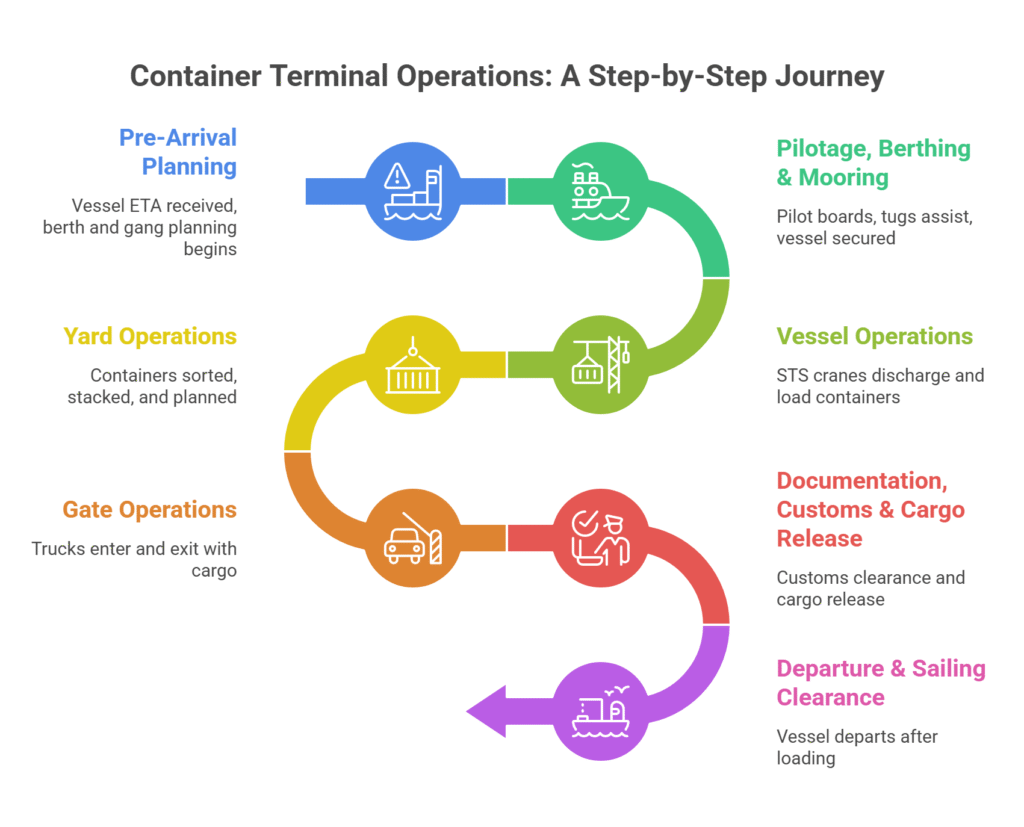
Step 2 — Pilotage, Berthing & Mooring
Once the vessel approaches, a harbor pilot boards at the pilot station. Tugs move into position — pushing, holding, controlling the swing. At Chittagong, tidal windows add a constraint that does not exist at every port. A vessel that misses its tidal window can wait hours for the next one, even if a berth is free.
When the vessel is alongside, mooring lines are made fast, the gangway comes down, and the pre-planned work begins.
Maersk Moment #1 — At Maersk, several vessels take berth at Chittagong each week. One call from December 2025 shows what a tidal constraint looks like in practice.
Vessel MAERSK XYZ was due at the pilot station on 12 December 2025 at 10:00. Bad weather in mid-sea slowed the vessel despite maximum safe speed. It arrived at 14:00 — four hours late. That was enough to miss the tidal window for the day.
Our berthing planning team coordinated with port control multiple times to arrange the next slot. The berth was vacant. But the vessel could not take it. We had to wait for the next day’s tidal window. One missed window costs a full day at anchorage — more time, more cost, and a lost schedule opportunity. The tidal window does not negotiate.
Step 3 — Vessel Operations: Discharge & Load Planning
With the vessel secured, the STS cranes — ship-to-shore cranes — move into position over the hatches. Crane deployment follows the sequence from pre-arrival planning: which hatch opens first, how many cranes work at once, and the order in which containers come off.
The spreader locks onto the corner castings of a container. It does the actual gripping. Spreader selection depends on container type and size. A 20-foot box and a 40-foot high cube need different setups.
Crane intensity — how many cranes are on a vessel — is a planning decision, not just an availability question. More cranes do not mean faster operations. If two cranes work adjacent hatches and their yard landing zones overlap, they interfere. If the yard cannot absorb containers fast enough, crane productivity drops regardless of how many cranes are running. The bottleneck moves from the quayside to the yard.
Two productivity figures matter. Gross Crane Rate (GCR) counts all time from first to last move, including delays. Net Crane Rate (NCR) counts active working time only. The gap between them is where inefficiency hides.
For exports, the sequence runs in reverse. Load order follows the stowage plan — bay, row, and tier for each container on board. The TOS coordinates the yard to pre-position export boxes in the right pickup sequence.
Step 4 — Yard Operations: Sorting, Stacking & Planning
After discharge, internal transfer vehicles — or AGVs in automated terminals — carry containers from the quayside to the yard. RTG cranes — Rubber Tyred Gantry cranes — stack them into rows.
The yard splits into import and export stacks. Import boxes wait for customs clearance and truck pickup. Export boxes are pre-positioned by vessel load sequence. Reefer containers need powered plug points and regular temperature checks.
Yard planning decides where each container lands. A well-planned yard keeps dwell time low and truck turnaround fast. A congested yard — high density, poor stack sequencing, or slow evacuation — pulls down crane productivity at the quayside even when the vessel runs smoothly. The yard is often the real bottleneck. Not the ship.
Maersk Moment #2 — Yard congestion is predictable when you know the calendar. I saw a clear example during the 2024 Eid al-Fitr period.
In the week before the seven-day holiday, importers rushed to clear cargo and take delivery. The yard was packed — trucks and trailers moving constantly, stack density climbing each day. Then the holiday started. Deliveries dropped sharply. But vessels kept arriving and discharging. Import units are stacked up with nowhere to go. Yard density crossed 100%.
The effect was immediate. Trailer turnaround time jumped from 3 minutes to 15 minutes. Cranes at the quayside sat idle, waiting for trailers stuck in a congested yard. Crane productivity collapsed — not because of anything wrong at the ship, but because the yard had run out of room.
We pushed the terminal to prioritize deliveries and clear space. The situation eased gradually. Trailer turnaround came back down to 5 to 8 minutes. Operations recovered. But the lost productivity could not be recovered. The yard is not passive storage. It is the engine room of the whole operation.
Step 5 — Gate Operations: Truck In / Truck Out
The gate is where the terminal meets the road. For import cargo, a truck arrives with a delivery order — the DO — which clears the collection of a specific container. The gate checks truck and container data. Containers are inspected for seal integrity before release. For exports, the gate-in process records container details, weight, and documentation before the box enters the yard.
A slow gate creates a queue on the road outside the terminal. That queue cuts truck cycle time and reduces daily trips. If it persists, it pushes back on yard density and quayside productivity. The gate is the last control point. But its failures move in both directions.
Step 6 — Documentation, Customs & Cargo Release
Physical handling and documentation rarely move at the same speed. A container can be discharged, moved to the yard, and stacked within hours of arrival. Customs clearance depends on manifest accuracy, importer compliance, and processing time. The terminal does not control any of those.
The manifest — the official cargo list — must be filed before or right after vessel arrival. Any gap between the manifest and the actual cargo triggers a hold. For FCL shipments, one importer owns the container and manages their own clearance. For LCL, cargo from multiple shippers must be deconsolidated first. That adds a step before individual consignments can be released.
Pre-arrival processing is the most reliable fix. Filing documentation before the vessel berths compresses the gap between physical availability and cargo release. Every extra day a container waits in the yard on a document is dwell time that someone pays for.
Step 7 — Departure & Sailing Clearance
Once loading is complete and the final bay plan is confirmed, the sailing pilot arrives. Sailing clearance is issued, tugs take position, and the vessel departs.
From ETA to ETD — Estimated Time of Departure — every step in this post sits inside that window. Vessel turnaround time, from arrival at anchorage to departure from berth, is the single KPI that shows how well all of it holds together.
Key Performance Indicators in Container Terminal Operations
Five KPIs drive how performance is measured in container port operations. Each tells part of the story. None tells the whole story alone.
- Crane moves per hour (CMPH) measures quayside productivity — container lifts completed per hour of working time. It is the most visible metric in vessel operations. But it only shows what is happening on the ship.
- Vessel turnaround time measures the total time from arrival at anchorage to departure from berth. Chittagong cut this from roughly four days to 2.53 days through better equipment, digitalization, and tighter planning. That is the benchmark.
- Berth occupancy rate measures how much of a berth’s available time is in use. Push it too high and the scheduling buffer disappears — vessels start waiting.
- Container dwell time measures how long a box sits in the yard between discharge and collection. High dwell time costs importers money and chokes the yard.
- Yard utilization measures the percentage of yard capacity in use at any time. Above roughly 80 percent, stacking efficiency drops, and truck cycle times grow.
These KPIs pull against each other. Pushing crane moves per hour can overload the yard and spike dwell time. Filling every berth slot lifts occupancy but leaves no room to absorb a late vessel. The goal in container terminal operations is not to win one number. It is to keep the whole system in balance.
Container Terminal Automation: How Technology Is Reshaping Terminal Operations
Behind every crane lift, yard move, and gate transaction sits a Terminal Operating System — the TOS. It is the software brain of a container terminal. It tracks vessel positions, yard stacks, crane assignments, equipment status, and truck movements in real time. Without it, running a modern container terminal at scale is not possible.
Automation goes beyond the TOS. E-gate systems read truck and container data at entry and exit points. This cuts processing time and reduces gate queues. Pre-arrival processing lets documentation be checked before a vessel berths. In fully automated terminals, AGVs — Automated Guided Vehicles — move containers between quayside and yard without a driver.
At Chittagong, the gains from digital integration are visible. Patenga Container Terminal has recorded reduced waiting time and faster turnaround. Better equipment use and operating discipline drove those gains — not new infrastructure.
One caveat matters. Automation at the berth does not fix slow customs processing. A well-configured TOS does not clear inland depot congestion or solve truck shortages. Container terminal automation improves what happens inside the terminal fence. The wider logistics chain still has to keep up.
Port Terminal Operations in Bangladesh: Chittagong’s Scale and Challenges
No single terminal in Bangladesh carries more weight than Chittagong. Close to 99% of the country’s containerized cargo moves through this port. How container terminal operations perform here is not just an operational question. It is a national supply chain question.
The 2025 numbers show real progress. Chittagong handled 3.4 million TEUs across 4,273 vessel calls. Turnaround time came down to 2.53 days. On multiple days in late 2025, the port recorded near-zero vessel waiting time. That would have been hard to imagine a few years earlier.
Two terminals lead this performance. The New Mooring Container Terminal is the clearest local example of what digitalization and discipline can deliver without adding new berths. Patenga Container Terminal adds capacity and handling flexibility as a key secondary facility.
The structural challenge has not gone away. UNCTAD has noted that inland connectivity and logistics integration in Bangladesh remain underdeveloped. A vessel can turn around in 2.53 days and still leave cargo sitting in the chain for days longer. Customs processing, ICD capacity, and truck availability have not moved at the same pace as berth performance.
That gap is where the next phase of improvement must happen. Three projects are expected to change the picture: Bay Terminal by 2033, Matarbari Deep Sea Port by 2027, and Laldia Container Terminal LCT by 2030. All timelines are as of early 2026.
5 Common Mistakes in Container Terminal Operations (And How to Avoid Them)
Mistake 1: Confusing vessel arrival with cargo readiness
The ship is at outer anchorage. The cargo is not ready. These are two different things. Treating them as the same causes more avoidable delay than almost anything else in container port operations. Yard positions may not be assigned. Customs documents may be incomplete. Labor deployment may not match the plan. The fix: confirm readiness across all four zones — quayside, yard, gate, and documentation — before the vessel arrives, not after.
Mistake 2: Optimizing one KPI at the expense of others
Pushing a crane moves per hour without checking the yard capacity is one of the most common errors in terminal operations. Cranes move faster. Containers pile up. Truck cycle times lengthen. Productivity falls anyway. No single metric in container terminal operations works alone. The fix: plan KPIs together — yard density and gate throughput in the same conversation as crane rate.
Mistake 3: Siloed planning between berth, yard, and gate teams
When berth planners, yard controllers, and gate supervisors work from different data on different timelines, the gaps become delays. In a well-run terminal, these functions run as one system through a shared TOS. The fix: real-time data visibility across all teams — not end-of-shift reports.
Mistake 4: Underestimating the landside effect
This is most relevant at Chittagong. A vessel can work well at berth and still leave cargo sitting in the yard for days. Truck availability, ICD capacity, and customs processing may not keep up. Terminal performance does not end at the gate. The fix: measure and manage landside evacuation with the same discipline applied to crane productivity.
Mistake 5: Ignoring ETA accuracy
An inaccurate ETA is not a small admin issue. It cascades. Berth windows are misallocated. Gang planning is built on the wrong arrival time. Yard pre-positioning goes off sequence. Crane deployment gets reworked at short notice. The fix: treat ETA updates as critical operational data. In container terminal operations, they are.
FAQ Section
What is the operation of a container terminal?
Container terminal operations are the process of moving containers between the vessel and the shore. It covers pre-arrival planning, berthing, discharge, yard storage, gate release, customs coordination, and departure. Cranes, yard equipment, trucks, documentation, and software all work in sequence to turn a vessel around as efficiently as possible.
What are the functions of container terminals?
A container terminal serves five functions: berthing vessels at the quayside; discharging and loading containers using ship-to-shore cranes; storing containers in the yard; handling customs clearance and cargo documentation; and transferring containers to inland transport. Every container cargo operation that moves through a port depends on these functions running in order.
What are terminal operations?
Terminal operations cover all activities needed to receive, handle, store, and dispatch cargo within a terminal. In container shipping, it runs from the moment a vessel gets a berth window to the moment it sails — and everything that happens to the cargo in between.
What is the difference between ETA and ETB in container terminal operations?
ETA — Estimated Time of Arrival — is when the vessel is expected at the anchorage or pilot station. ETB — Estimated Time of Berthing — is when it is expected alongside and ready to work. The gap between the two is the anchorage waiting time. A wide ETA-to-ETB gap is one of the earliest signs of port congestion.
What are FCL and LCL?
FCL — Full Container Load — means one shipper fills a container for one consignee. LCL — Less than Container Load — means cargo from multiple shippers shares a container. FCL boxes move from the vessel to the yard to the gate. LCL shipments need a deconsolidation step at a freight station before individual consignments can be released.
Key Takeaways
- Container terminal operations coordinates four zones — berth, yard, gate, and documentation — into one system. A delay in any one moves through the others.
- The process runs in seven steps, from ETA notification and pre-arrival planning through to sailing clearance.
- The core equipment and technology: STS cranes, RTGs, AGVs, and a TOS tracking everything in real time.
- Chittagong Port handles close to 99% of Bangladesh’s containerized cargo. Performance here is a national supply chain issue.
- The real bottleneck is usually the yard or the landside — not the vessel. Fast crane rates mean little if the yard is full or trucks cannot move cargo out.
- KPIs like crane moves per hour, dwell time, and berth occupancy must be read together. Optimizing one in isolation damages the others.
Conclusion
Go back to that moment at the quayside. The vessel is swinging into berth. Tugs holding position. STS cranes are repositioning overhead. It looks like a hardware problem — big machines moving big boxes. But you now know that what determines success is everything that happened before the vessel arrived. And everything coordinated across the yard, gate, and documentation chain while it is alongside.
Container terminal operations are a coordination problem. Equipment matters. Infrastructure matters. But neither delivers results without planning discipline, real-time information flow, and the four zones working as one system.
That is true at the world’s most automated ports. It is true at Chittagong. And it is true for every container cargo operation in between.