
Your cargo is on the vessel. The vessel has arrived at the Port of Discharging (POD). And yet — nothing is moving.
You call your Clearing and Forwarding (C&F) Agent. They say the ship is “at anchorage.” You check the tracking portal. It confirms the vessel arrived yesterday. So why is your container still sitting offshore?
If you’ve been in this situation, this post is for you.
Most people in shipping know pieces of the picture: the booking, the bill of lading, the ETA, and the delivery order. But port operations are what happen in the middle. It determines whether your cargo moves smoothly — or sits for days, generating costs you didn’t plan for.
I work in vessel and terminal operations at Maersk Bangladesh. I monitor port performance across Chittagong, Patenga, and Mongla every day. This guide explains exactly what happens between vessel arrival and cargo delivery — and why it doesn’t always go to plan.
What are port operations in container shipping? Port operations is the end-to-end coordination of vessel arrivals, cargo handling, yard management, customs clearance, and gate delivery at a container terminal. Multiple stakeholders work in parallel — port authority, terminal operator, shipping line, stevedore, and customs — to move containers from ship to shore and out the gate. Key metrics include Crane Moves Per Hour (CMPH), Berth Occupancy Rate, Dwell Time, and Vessel Turnaround Time (TAT).
What Is Port Operations? (And Why It’s More Than Just Discharging and Loading Ships)
Port operations is the system that manages everything from the moment a vessel approaches port to the moment the last container clears the gate. It covers vessel arrival, cargo discharge and loading, yard storage, customs documentation, and final delivery — all running at the same time, not one after another.
Here’s something that confuses even experienced logistics professionals: port operations and terminal operations are not the same thing.
Port operations is the big picture — the waterway, berth allocation, regulations, and stakeholder coordination across the entire port. Terminal operations are the execution on the ground: the cranes, the yard, the gate. One is the orchestra. The other is one section of it.
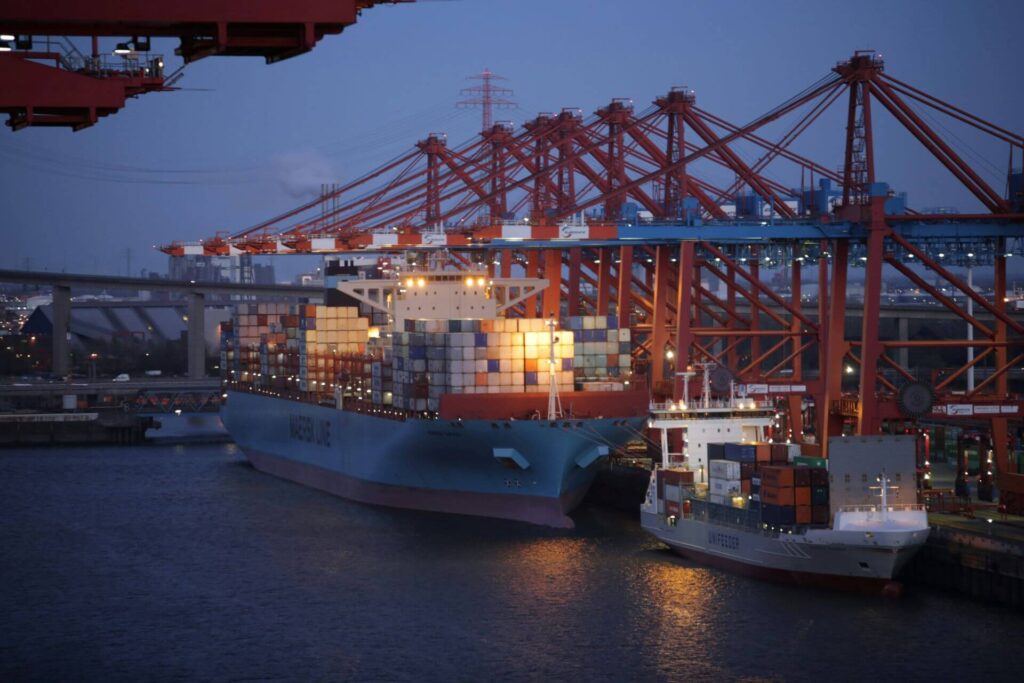
Six key players make the system work. The Port Authority governs the waterway and allocates berths. The Terminal Operator runs the cranes, yard, and gate systems. The Shipping Line manages the vessel schedule and cargo plan. Stevedores handle the physical loading and discharge. Customs controls document clearance. And Freight Forwarders / C&F Agents coordinate on behalf of the cargo owner. When all six are aligned, containers move from ship to gate without friction. When one link breaks, the whole chain feels it.
The Key Stakeholders in Port Operations
Port Authority vs. Terminal Operator — What’s the Difference?
People confuse these two all the time — even those working in the industry.
The Port Authority is the governing body. It controls the waterway, sets safety rules, approves berthing, and manages vessel traffic. The Terminal Operator runs what’s inside the terminal: cranes, yard equipment, gate systems, and the Terminal Operating System (TOS).
Think of it this way: the Port Authority is the landlord. The Terminal Operator runs the business on the premises. The landlord sets the rules. The tenant runs the shop floor.
The Shipping Line’s Role
The shipping line sits at the center of pre-arrival planning. It handles vessel scheduling, stowage planning, and terminal coordination — cargo manifests, bay plans, and special cargo notices. This work starts days before the vessel reaches port.
Maersk Moment #1 — At Maersk Bangladesh, we handle many vessel calls at Chittagong Port every month. When a vessel leaves its last port, our berthing planning team contacts the vessel for its ETA and arrival draft. Chittagong is a tidal port. Berthing runs on a FIFO basis. We share the ETA with the Chittagong Port Authority (CPA). Based on the sequence, we guide the vessel on its berthing window.
Once the vessel berths, our vessel and terminal operations team coordinates across all stakeholders. We manage arrival notifications, discharge follow-up, import holds, stowage plan approvals, laden and empty container programs, health and safety, stevedore damage reporting, congestion updates, productivity tracking, and post-departure activities.
By the time a ship berths, operates, and sails, dozens of decisions have already been made. When any one of them is late, the whole sequence shifts.
Stevedores, Customs, and Freight Forwarders/Clearing and Forwarding (C&F) Agents
Stevedores do the physical work — lashing, unlashing, and crane signaling between vessel and quayside. Their speed decides how long the vessel stays at berth.
Customs is the documentation gatekeeper. No clearance, no delivery. Delays here extend dwell time, raise storage costs, and congest the yard — especially during peak RMG export seasons at Chittagong.
Freight forwarders and C&F agents coordinate on the cargo owner’s side — documents, customs filing, and transport. They are usually the first to receive complaints about delays. They are often the last to have had any control over what caused them.
How Port Operations Work — Step by Step
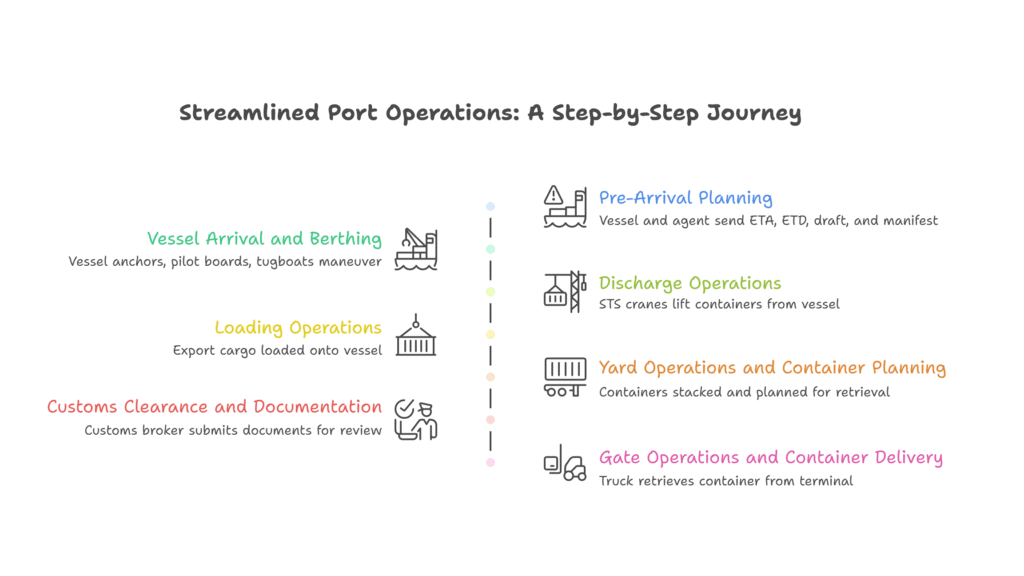
Step 1 — Pre-Arrival Planning
Port operations start long before the vessel reaches the harbor. Days ahead of arrival, the vessel and shipping agent send the ETA, ETD, declared draft, and cargo manifest to the port authority and terminal. The terminal checks berth availability, confirms the tide window against the vessel’s draft, and verifies equipment readiness.
Get this phase wrong — a late manifest, an unchecked draft, a missed tide window — and the problems show up at the berth, not at the desk.
Step 2 — Vessel Arrival and Berthing
On arrival, the vessel anchors at the outer anchorage and waits for berth clearance. A harbor pilot boards to guide the vessel through the channel. Tugboats help maneuver it to the berth. Berth allocation depends on vessel size, draft, cargo type, and terminal occupancy.
Here’s the misconception: arriving on schedule does not mean an immediate berth. If berth occupancy is high, yard capacity is tight, or equipment is busy with another vessel, the ship waits at anchorage. Sometimes for days. Arrival and operations start are two separate events.
Step 3 — Discharge Operations
Once moored, Ship-to-Shore (STS) cranes position over the vessel’s bays. Discharge follows the bay plan — the document that maps which container sits where on the ship. Containers lift off the vessel and move onto terminal tractors (TT) or Automated Guided Vehicles (AGVs) for yard transfer.
Vessels without their own cranes are called gearless (GL) vessels. They need STS crane support. Vessels with their own cranes are called geared (GD) vessels.
The key metric here is Crane Moves Per Hour (CMPH). It measures how many container lifts a crane completes each hour. It decides how long the vessel stays at berth. A drop in CMPH doesn’t just slow discharge — it delays every vessel scheduled behind this one.
Step 4 — Loading Operations
Loading runs alongside or right after discharge, depending on the vessel’s schedule. The shipping line nominates export cargo. Notifications go to Container Freight Stations (CFSs) to send laden and empty units to the terminal before the cut-off time. Miss the cut-off — miss the vessel. No exceptions.
Nominated containers are pre-stacked in the yard before loading begins. Before any box goes on board, the stowage plan and bay plan need approval from the vessel master, the shipping line’s central planner, and the terminal vessel planner. Loading then follows vessel positioning — the order in which cranes work each bay to keep the vessel stable throughout the operation.
Step 5 — Yard Operations and Container Planning
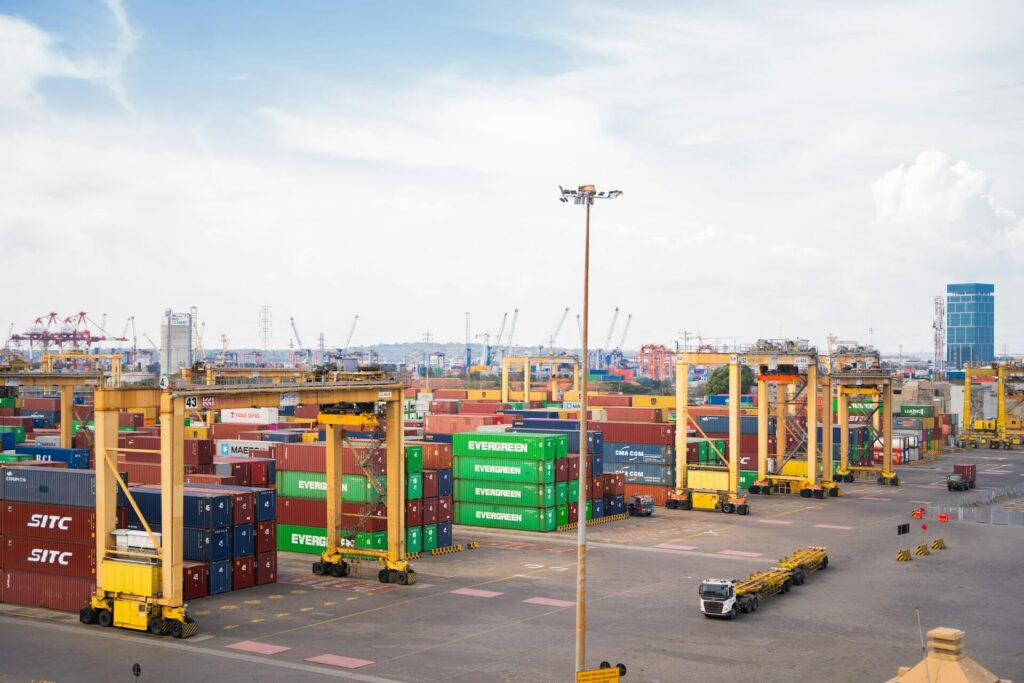
The yard is where port operations either flow or break down. Discharged containers move by Rubber-Tyred Gantry cranes (RTGs) or reach stackers (RSTs). They stack by vessel, voyage, and destination. Yard planning sets where each container goes — based on retrieval order and truck access.
Poor yard planning compounds fast. Vehicle wait times rise. Rehandling increases. Yard utilization climbs toward the congestion threshold. Above roughly 85% utilization, the whole terminal slows down. Every extra move is time and cost that shouldn’t exist.
Step 6 — Customs Clearance and Documentation
While yard operations continue, the documentation chain runs in parallel. The importer’s customs broker submits the Bill of Lading, Delivery Order, and cargo manifest for customs review. Clearance status decides when the importer can collect their container.
Delays here — missing documents, classification disputes, inspection holds — push dwell time up. The container sits. The free time window shrinks. Demurrage charges start to build. Customs clearance is invisible to most people outside the process. But it is one of the most important variables in the entire port cycle.
Step 7 — Gate Operations and Container Delivery
The importer’s truck arrives at the terminal gate with the Delivery Order and driver ID. Gate staff checks documents. The system confirms clearance. The weighbridge verifies the container’s declared weight. The yard system allocates the container and sends equipment to retrieve it.
Gate-out — the scan recording the container leaving the terminal — marks the end of the port cycle. From here, it’s road or rail. The port’s job is done.
Key Performance Metrics in Port Operations
Five metrics tell you almost everything about how a terminal is performing.
- Crane Moves Per Hour (CMPH) — also called Gross Moves Per Hour (GMPH) — counts how many container lifts a crane completes each hour. It is the main indicator of quayside productivity. Faster crane moves mean shorter vessel time at berth. World-class terminals target 100+ moves per hour. At Chittagong Port, the struggle lies within 20-25.
- Berth Occupancy Rate (BOR) measures the percentage of time a berth is in active use. The industry benchmark is 70–85%. Below that, the terminal is underused. Above it, vessels queue at anchorage, and waiting time (WT) rises.
- Dwell Time tracks how long a container sits in the yard after discharge. It is a silent cost driver. Every extra day adds storage charges and takes up yard space. Best practice targets dwell time under 3–4 days. At Chittagong Port, dwell time regularly stretches beyond that during peak seasons — adding storage charges that directly erode the importer’s landed cost margin.
- Vessel Turnaround Time (TAT) is the total port time from arrival to departure. Chittagong’s TAT runs well above benchmark ports like Singapore or Hong Kong. Laldia Container Terminal and Bay Terminal aim to close that gap.
- Yard Utilization Rate — also called Yard Density — monitors how full the yard is. Once it crosses 85%, congestion sets in. Rehandling rises. Equipment slows. The whole terminal feels it.
Maersk Moment #2 — Chittagong is a tidal port. Berthing and sailing must happen in the same tide window — usually 4-hours per day. When vessels bunch at the outer anchorage, waiting time rises quickly. This is something we deal with directly. Our vessels face waiting time, higher TAT from yard congestion, and lower CMPH from slower equipment. Compared to hub ports in Singapore, Malaysia, or China — Chittagong has real room to improve.
At Maersk, I had good days where everything ran clean: solid crane movements, smooth yard flow, strong cargo dispatch from CFSs, and almost no idle hours. I also had bad days where I forgot to eat and drink due to long crane downtime, slow yard movement, poor CFS support, and productivity that drags from start to finish.
Port Operations in Bangladesh — Chittagong, Patenga, and Mongla
No port defines Bangladesh’s trade more than Chittagong. It handles 92–98% of the country’s containerized cargo. In 2025, Chittagong Port Authority (CPA) recorded 3.41 million TEUs — up 4.07% year-on-year. In 2024, it handled 2,314 vessel calls. Of those, 53% were container vessels.
The operational reality at Chittagong is one of constant pressure. Berth occupancy runs high. TAT lags behind Colombo and Singapore. The RMG export cycle creates seasonal surges that stress the yard and gate at the same time. These are structural constraints — not operational failures. Anyone planning shipments through Bangladesh needs to understand them.
Patenga Container Terminal sits next to CPA. It adds capacity for feeder and smaller container vessels. This takes some pressure off the main terminal. Mongla Port, in the southwest, handles mostly bulk and project cargo. Container activity there is limited to 2-5% but growing. Mongla primarily serves importers in Khulna, Rajshahi, and southwest Bangladesh — cargo types include industrial equipment, project materials, and garment accessories. For these importers, routing through Mongla avoids the additional inland transport cost of going through Chittagong.
Three developments will reshape Bangladesh’s port landscape. Laldia Container Terminal (LCT) — designed and built by Maersk APM Terminals — targets readiness by 2030. Bay Terminal targets 2033. Both add capacity to the Chittagong ecosystem. Matarbari Deep-sea Port is the bigger shift — it targets partial operation by 2027. All three are built to receive large and post-Panamax vessels that CPA’s draft limits cannot handle today. Together, they aim to cut Bangladesh’s dependence on Singapore, Malaysia, and Colombo as transshipment hubs.
Maersk Moment #3 — At Chittagong, vessels are limited to a 10-meter draft and 200-meter LOA. Mongla is tighter still — 7.5-meter draft. Moreover, we have tide-dependent berthing and sailing, and very limited night navigation. Add manual equipment, aging infrastructure, and limited terminal technology — and you have a port ecosystem where capacity growth is slow, and efficiency gains are hard-won.
At Maersk Bangladesh, we live with these constraints every day. Seasonal surges push yard utilization toward the congestion line. At other times, berth occupancy drops. Both extremes bring their own operational challenges.
Common Mistakes in Port Operations (And How to Avoid Them)
Mistake 1: Assuming vessel arrival means cargo is available
It doesn’t. Berthing, discharge, yard movement, and customs clearance all follow arrival — each with its own timeline. Many importers start customs prep only after the vessel berths.
Fix: Start document preparation against the ETA — not the berth report.
Mistake 2: Ignoring free time windows
Free days start ticking after discharge — not after vessel arrival. Within 48–72 hours, demurrage and detention charges can grow fast.
Fix: Know your free time clause before the vessel sails — not after it berths.
Mistake 3: Trusting ETA without checking berth congestion
ETA and actual operations start are different things. Freight forwarders who build delivery commitments on ETA alone are setting clients up for disappointment.
Fix: Cross-check ETA against live berth occupancy data. Build a minimum 3-day buffer into any delivery commitment at the time of booking.
Mistake 4: Underestimating yard and gate delays
Discharge is only the start. Yard rehandling, customs holds, and truck queues at the gate often cause more delay than the vessel operation itself.
Fix: Arrange trucking and customs coordination before discharge is complete — not after.
Mistake 5: Wrong container type selection
A dry box for temperature-sensitive cargo, or an oversized load in a standard unit — these mistakes get caught late and fixed at high cost.
Fix: Confirm commodity requirements against container specs at the booking stage.
The Future of Port Operations — Automation, AI, and Digital Integration
The leading terminals have already moved. Shanghai handled 55.06 million TEUs in 2025 with full-scale automation — AGVs, robotic cranes, and IoT container tracking as standard, not as pilots.
Terminal Operating System (TOS) software now ties berth scheduling, yard planning, gate operations, and vessel tracking into one platform. AI-driven vessel operations go further — predictive berthing algorithms pull live shipping schedules and congestion data to set berth windows before a vessel reaches anchorage. Digital twins let planners simulate congestion and test decisions without touching live operations.
South Asia is in early-to-mid adoption. Chittagong is modernizing in steps. The bigger jump will come with Laldia Terminal and Bay Terminal — both designed with automation as a core requirement, not an afterthought. In my assessment, Chittagong will undergo a major transformation in the next 10-15 years. By 2040, Chittagong will be a hub port, not depending on other major ports for transshipment.
Ports that invest in terminal operations software and AI tools will keep widening their efficiency gap. That gap will increasingly determine where shipping lines choose to call.
Major carriers, including Maersk and MSC, have restructured their networks in recent years — skipping congested or underperforming ports in favor of higher-reliability alternatives. For Maersk’s Gemini Cooperation, port productivity is now a core criterion for hub selection. Productivity is no longer just an operational metric — it is a commercial one.
FAQ Section
What is the difference between port operations and terminal operations? Port operations is the full system — vessel traffic, regulations, berth allocation, and stakeholder coordination. Terminal operations are the execution inside the terminal: cranes, yard, gate systems, and the TOS. One runs the system. The other runs the floor.
Why do container ships wait at anchorage even after arriving on time? On-time arrival does not guarantee a berth. A prior vessel running late, high berth occupancy, yard congestion, or equipment shortages can hold a vessel at anchorage for days. Arrival and operations start are independent events.
What is dwell time in container shipping? Dwell time is the number of days a container sits in the yard after discharge before the importer collects it. High dwell time creates demurrage charges and consumes yard space — adding directly to terminal congestion.
What KPIs measure port efficiency? The five key metrics are Crane Moves Per Hour (CMPH), Berth Occupancy Rate (BOR), Vessel Turnaround Time (TAT), Dwell Time, and Yard Utilization Rate. Together, they give a clear picture of terminal performance.
How will Bay Terminal affect Chittagong operations? Bay Terminal is built to receive post-Panamax vessels that CPA’s draft limits cannot handle today. Once operational, it will reduce Bangladesh’s dependence on Colombo, Singapore, and Malaysia as transshipment hubs — and ease structural congestion at CPA.
What skills do you need to work in port operations jobs? Port operations roles reward a mix of technical knowledge and coordination ability. On the technical side, you need to understand vessel operations, terminal systems, cargo documentation, and key metrics like CMPH, TAT, and dwell time. On the soft skills side, stakeholder coordination, attention to detail, and calm decision-making under disruption matter most. A background in maritime studies, supply chain, or logistics is common. Certifications like CSCA or a port operations diploma strengthen your profile considerably for entry-level and mid-level roles.
Key Takeaways
- Port operations cover the full cycle: pre-arrival planning → berthing → discharge → yard → customs → gate-out.
- Port Authority, Terminal Operator, Shipping Line, Stevedore, Customs, and C&F Agents each control a distinct part of the process — a breakdown in any one affects all the others.
- Vessel arrival and cargo availability are not the same thing — berth congestion, yard capacity, and documentation status each run on their own timeline.
- CMPH, BOR, TAT, Dwell Time, and Yard Utilization Rate are the five metrics that define terminal efficiency.
- Chittagong Port handles roughly 95% of Bangladesh’s containerized trade — Laldia Terminal, Bay Terminal, and Matarbari are the three projects addressing its structural constraints.
- The slowest part of port operations is often not the ship — it’s the yard, customs, and the gate.
Conclusion
Remember that vessel sitting at anchorage — arrived on time, going nowhere? You now know exactly why.
Behind that waiting ship is a system of berth allocations, yard thresholds, document chains, and stakeholder handoffs that all have to line up before operations can begin. Port operations are not one thing. It is a sequence running across a port authority, terminal operator, shipping line, stevedore, customs team, and freight forwarder — at the same time, under time pressure, with real costs attached to every hour of delay.
Whether you’re a student building your logistics knowledge, a freight forwarder managing client expectations, or an importer tracking your cargo — understanding this system makes you better at your job.
Port operations aren’t a black box anymore.